Signed in as:
filler@godaddy.com
Signed in as:
filler@godaddy.com
Welcome to Indigenous Insight's Online Indigenous Engagement Training course.
Once payment has been made, course access will be provided to course learning modules via links sent by e-mail. Please click HERE to complete survey and provide name, reason you are taking this course, your e-mail and other relevant contact information. Upon completion, you will receive access to the Indigenous Engagement e-course via module links sent to your contact e-mail
This Indigenous studies cultural awareness training course was developed in Coast Salish territory, specifically, Tla’amin Nation lands. I hold my hands up to our First Nation ancestors powho came before us, faced challenges, hardship, heartbreaks, even I find hard to imagine. Our ancestors did their job providing for our people, protecting our territories, languages, cultures, and in doing so, all paid a heavy price in so many ways. 24/7/365, they always demonstrated strength, resilience, integrity.
I acknowledge our Elders, Indian Residential School Survivors, 60’s Scoop Survivors and Indian Reserve community leaders, all trying valiantly to fill shoes vacated by our ancestors in facing head-on, the lasting impacts and challenges imposed by Canada’s Indian Policies, which still includes Canada’s Indian Act, Indian Reserve and Indian Residential School System.
I acknowledge our First Nation youth who inherit our efforts, both good and bad. I do think we all tried our best to provide all of you the tools and skills to decolonize our people by protecting our true heritage, our territories, languages and cultures. Your struggles and efforts will be difficult. Look back to your ancestors for strength and motivation. To you, our youth – our ancestors, Survivors and our people, hold you up high.
i?mote (meaning 'very well' in the Tla'amin Nation Coast Salish language).

Indigenous engagement is the process of building respectful, meaningful, and ongoing relationships between Indigenous communities and non-Indigenous governments, organizations, or businesses. It must go beyond mere consultation or checkbox exercises by actively listening, recognizing Indigenous rights and title, honouring cultural protocols, and ensuring Indigenous voices shape decisions that affect their lands, resources, and futures. At its core, Indigenous engagement is about partnership, trust, and accountability — creating space for Indigenous worldviews, knowledge, and leadership to guide shared paths forward.
Indigenous cultural awareness training deepens understanding of how Canada was colonized and its failure to extinguish Aboriginal title as required by the Royal Proclamation of 1763. This unresolved issue underlies more than 630 unanswered land questions nationwide, including over 190 in BC alone, where many First Nations assert their territories remain unceded.
The training addresses widespread gaps in non-Indigenous Canadians’ knowledge, guiding participants through often uncomfortable but necessary truths about Canada's true colonization and assimilation history (e.g., Indian Act, Indian Reserve System, Indian Residential School System, band offices emerging as a colonial instruments), existing treaties (e.g., Numbered Treaties, Douglas Treaties) and modern-day treaty negotiations. This training details how Canada's Indian policies have impacted First Nation Indian reserve communities.
Please Note: videos in this course are not Hollywood production. All videos were recorded in a modest home office, with the priority placed on truth, lived experience, and authenticity—not polished sound and lighting. This Indigenous engagement course is a living program—it will grow, adapt, and evolve over time.
This initial soft-launch represents Phase ONE. Phase TWO will be making the app more interactive.
COURSE VIDEOS: the course contains over 15 videos that dive into subjects many settler Canadians often overlook or misunderstand about Indigenous peoples. These knowledge gaps must be addressed before meaningful reconciliation can move forward.
For the best experience, we recommend registering and signing in with your YouTube account.
Indigenous cultural awareness training is often required because systemic inequities and colonial attitudes still shape Canada’s institutions and relationships. Those in power may mandate it to confront ignorance, bias, and privilege that remain deeply rooted in society. Though it may feel forced, its purpose is clear—to expose uncomfortable truths, demand accountability, and push non-Indigenous people beyond complacency toward genuine understanding and respect for Indigenous rights, histories, and realities.
This Indigenous engagement course will not make you an expert or master in the field. Rather, its purpose is to plant a seed of curiosity and provide you with a starting point for your own journey of learning and research.

1. Unresolved Aboriginal rights and title - Aboriginal rights and title, protected under the Constitution Act, 1982, remain Canada’s unresolved “land question.” Evolving case law has shaped how governments must address infringement, consultation, and accommodation, with the Supreme Court always urging negotiation as the preferred path to resolution.
2. Deeply flawed colonization and assimilation policies - Canada’s colonization and assimilation Indian policies (e.g., Indian Act, Indian Reserve, Indian Reserve Pass Systems, 162 years of Indian residential schools) caused a cultural genocide by eroding Indigenous land, languages, identities. Rooted in Euro-assumptions of cultural inferiority, these policies created intergenerational trauma and continue to fuel the social, economic, and political marginalization of Indigenous peoples.

Module 1: Introduction and Basics About Indigenous Peoples
Module 2: Canada's Colonization History
Module 3: Canada's 'Land Question'
Module 4: Truth and Reality First, Only Then Reconciliation
There are no exams—only meaningful learning. At the end of this learning journey, you will not be an Indigenous engagement expert but you will receive a certificate of completion.
On a personal level, I find it odd that other cultures in Canada are expected to learn about Indigenous cultures, while Indigenous peoples are never forced to learn about other cultures.
Bestowed the ancestral name KWAST-en-ayu by the Tla’amin Elders on May 10, 2003, L. Maynard Harry brings more than 31 years of profound, practical, lived experience rooted directly in Canada’s colonization history. KWAST-en-ayu's delivery of content s grounded, unapologetically authentic, rooted in lived experience that comes from making governance decisions under Canada’s Indian Act (as Indian Act–elected Hegus (Chief Councillor) and councillor; by a lifetime spent living on an Indian reserve; and by family experiences directly impacted by Canada’s Indian Residential School System. This course is from the perspective of a First Nation status Indian lens.
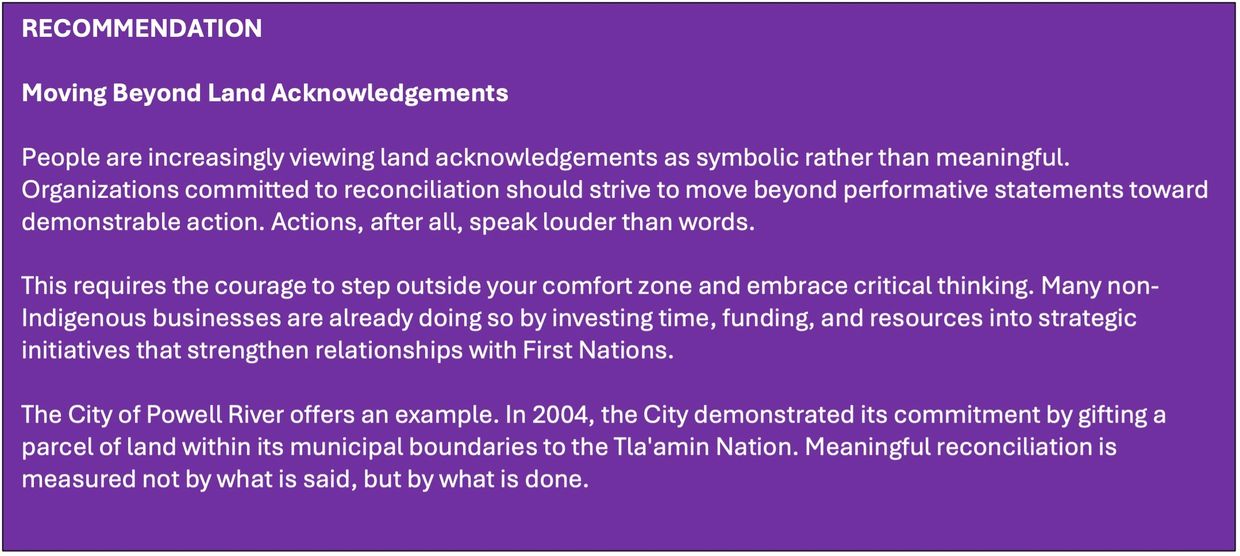
Maynard actively participated in his Nations struggles with protecting Aboriginal rights and title and address its land question through the BC Treaty Process as well as being principal signatory to the historic 2003 Tla'amin Nation-City of Powell River Community Accord and an honorary signatory to the reaffirmed 2018 Accord.
Maynard’s understanding of Canada’s colonization and assimilation history does not come from university courses or textbooks but from his work with Elders and community leaders.
When discussing Indigenous engagement in Canada, it is important to recognize the striking similarities between the 630+ recognized First Nation communities across the country, regardless of individual Indigenous culture, region, province, or territory. These similarities are due to forced imposition of colonial federal legislation (e.g., Indian Act), federal systems (e.g., Indian Reserve System, Indian Residential School System), and Canada’s involvement of powerful institutions such as the RCMP, Christian churches and provincial governments.
Colonizer Rehab Seminar Series
Registering for this course is more than a transaction. Learners automatically join the Colonizer Rehab Seminar Series for as long as they choose. This monthly series meets on the last Friday from 9:00 am to 11:30 am (PT), bringing together 15–20 participants to extend learning beyond the course into real-world application.
Throughout this course, “thought boxes” are used as exercises highlighting key knowledge gaps in non-Indigenous Canadians’ understanding of what it is like to be Indigenous in Canada.
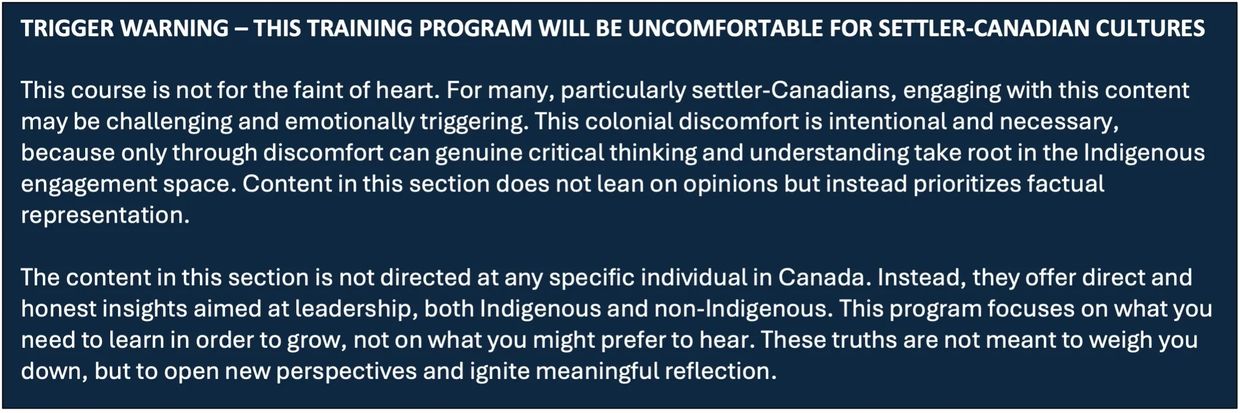
These are ‘Common Misconceptions’ boxes (highlighted in green), 'Historical Quotes', ‘Magnitude’ boxes (highlighted in orange), ‘Red Flags’ boxes (highlighted in dark red), ‘Reflections’ boxes (highlighted in blue) and 'Trigger Warnings'. These thought boxes clarify key topics that foster critical thinking and evolution of thought processes through analytical exercises. They will ask you to put yourself in the shoes of an Indigenous person to explore your perception of Indigenous issues as it relates to Canada.
There are no right or wrong answers. There are no exams. However, If you cheat at these exercises, you are doing what Canada has done 'since time immemorial'' - remained silent, inactive, ignorant. These three states of mind are why reconciliation moves so slowly. The content here does not distort, minimize or erase realities of colonization - it confronts and moves towards acknowledgement of truths.

Historical Quote Boxes (highlighted in light grey) will feature factual quotations from significant figures in Canadian Indigenous history.

Common Misconceptions boxes (highlighted in green) dispel myths and misunderstandings that often hinder relationships.

Magnitude boxes (highlighted in orange) illustrate the scale and depth of colonial impacts.

Red Flag boxes (highlighted in dark red) warn of common pitfalls in Indigenous engagement.

Reflections thought boxes (highlighted in blue) invite you to pause, reflect, and connect with the material.

Magnitude boxes (highlighted in orange) illustrate the scale and depth of colonial impacts.
Click HERE for video regarding summary of three (orange, green and blue) thought boxes below.

Recommendations are offered to those who will interact directly with First Nation communities. This could include staff, frontline workers, management, leadership, business development managers, directors.
Indigenous Insight is a 100% Aboriginal-owned company based on the traditional lands of the ɬaʔamɩn (Tla'amin) Nation and provides Indigenous engagement, cultural awareness training, and Aboriginal Rights and Title advisory services to businesses, organizations, associations, corporations, and all levels of government.